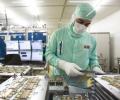
Mumbai-based Indian Semiconductor Manufacturing Company (ISMC) and Singapore-headquartered IGSS Ventures have one strategy in common: They have told the government in their application for semiconductor fabrication plants that they will export the bulk of the chips they make in India in the initial five or 10 years. The third applicant, Vedanta-Foxconn, which is also building a fab plant, has said it will concentrate on the needs of consumer electronics and mobile device markets, and earmark 80 per cent of output for domestic consumption, but has not specified its customers. Finding a viable domestic market could well be the biggest challenge for India's renewed tryst with semiconductors. Fab plants do not sell directly to end users but to intermediary chip design companies - such as Qualcomm or MediaTek.

'Unemployment barely figures in the Budget except as a derived demand from the industry and infrastructure.' 'There is no effort at direct attack on unemployment.'

India's growth projection released by the latest World Economic Outlook remains unchanged from its previous WEO (World Economic Outlook) update of July this summer but is a three-percentage point in 2021 and 1.6 percentage point drop from its April projections. According to the latest WEO update, released ahead of the annual meeting of the IMF and the World Bank, the world is expected to grow at 5.9 per cent in 2021 and 4.9 per cent in 2022.

The company is planning to invest Rs 1,100 crore in the new mobile phone manufacturing facility.

During the month, inflation in vegetables shot up to 35.99 per cent, as against 26.10 per cent in October. Likewise, the prices of cereals and eggs grew at a faster pace of 3.71 per cent.

The new IIP series based on the new base year, is expected to lead to better capturing of ground data

The company started the three-day week schedule since December in the wake of a drastic drop in demand. Tata Motors, which had in the recent past resorted to multiple temporary block closures at its units in Jamshedpur, Pune and Lucknow, is also watching the market demand.

Listing out the achievements of his government, he said the country has moved away from a culture of delaying work through 'atkana, latkana and bhatkana' (obstructing, delaying and misguiding).

Growth of capital goods at 9.6 per cent is inspiring as the investment cycle is expected to rebound in the coming months.

There may be some losers as well as winners. And those who lose their jobs to the new technology will soon find other employment, says Martin Feldstein.

India's services sector activity surged to a seven-year high in January driven by sharp increase in new business orders, leading to job creation and business optimism amid favourable market conditions, a monthly survey said on Wednesday. The IHS Markit India Services Business Activity Index rose from 53.3 in December to 55.5 in January, signalling the strongest upturn in output in seven years.

New projects fell 6.3 per cent in the December quarter compared with the September quarter. The value of new projects in the just-concluded quarter was Rs 2.1 trillion, according to the data from Centre for Monitoring Indian Economy (CMIE), which was lower than the Rs 2.2 trillion seen in the September quarter. It is, however, higher than Rs 1.5 trillion recorded for the quarter ended December 2020, the first year of the Covid-19 pandemic. This data ties in with the November data for core sector growth, an index of eight core industries, which grew at its slowest pace since early 2021.

Rating agencies Crisil and Icra on Monday revised down their India growth projections for the current fiscal and the second quarter mainly due to the ripple effect of slowdown in global growth and mixed crop output. Crisil downgraded the India growth forecast by 30 bps to 7 per cent while Icra pegged the economic expansion at 6.5 per cent for the second quarter of FY2022-23. "We have revised down our forecast for real gross domestic product growth to 7 per cent for fiscal 2023 from 7.3 per cent, primarily because of the slowdown in global growth that has started to impact our exports and industrial activity.
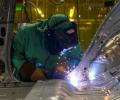
There was a slowdown in the manufacturing sector, which grew at 1.2 per cent in June 2019 as compared to 6.9 per cent a year ago.

Leading tyre maker Apollo also saw a production loss of 450 tonnes till December 2.

'Limited spillovers' to Asia's third-largest economy, even as world 'perilously close' to recession.

Certain clarifications by the GST Council, such as tax rates on ice cream parlours and royalty paid to state governments over mineral rights, may turn out to be contentious and lead to litigation, feel some experts. The council, at its meeting in Lucknow on Friday, had clarified that ice cream parlours will attract goods and services tax (GST). The clarification said these parlours sell already manufactured ice cream and such supply would draw 18 per cent tax.
India's industrial production shot up by 12.4 per cent in July 2006 as against 4.7 per cent in the same month last year.

India's GDP is poised to accelerate to 5.5 per cent in 2014-15 on the back of improved performance in industry and services but it may take some time for the country to reach its potential growth rate, says an Asian Development Bank (ADB) report.

I suggest we build a Vigyan Mandir (Temple of Science) with the ambience of a place of worship, so that it becomes a destination for pilgrims. We should embed on its walls bronze plaques describing each scientist mentioned here along with about a dozen of our ancient mathematicians, recommends Professor Kalyan Singhal, historian of science and technology.

IMF Chief Economist Gita Gopinath also said the pickup in global growth for 2020 remains highly uncertain as it relies on improved growth outcomes for stressed economies like Argentina, Iran, and Turkey and for under-performing emerging and developing economies such as Brazil, India, and Mexico.

According to the government data, micro, small and medium enterprises employ about 59.7 million people spread over 26.1 million enterprises.

No longer a discretion of the tax administrator, the audit of returns filed by taxpayers is now based on a selection by algorithms, notes Tarun Bajaj.
JLR sees job cut if the situation does not improve.

IIP growth rises to 9-month high of 4.3 pc in August

Increasing sugar production shall create problems for the industry, whereas boosting ethanol output can bring rich returns, Union Minister Nitin Gadkari told sugar mills on Wednesday. Speaking at a conference on sugar and ethanol, organised by the Indian Sugar Mills Association, Gadkari surprised the audience comprising senior executives of sugar mills by stating that the future will become bleak for the industry if it continues to churn out high quantities of sugar. "We need more ethanol than sugar. Also, bio-ethanol is the way to go as it can be stored for a longer duration as compared to conventional ethanol. "If you increase sugar production, it will create more problems for you.
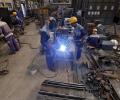
IIP down due to poor show by manufacturing, mining and power sectors
Led by a strong recovery in the manufacturing sector, the industry registered an impressive growth of 7.9% during August 2004 against 5.7% in the same month last year.

But lower growth numbers in the quarters to come may not mean renewed weakness in the economy at the ground level, says Pranjul Bhandari.

She also took a swipe at the Bharatiya Janata Party over its defeat in the just-concluded Himachal Pradesh assembly elections, saying the ruling party's president could not hold on to his home state. "Who is the Pappu now?" she asked.

Industrial production re-entered the negative territory by contracting 1.6 per cent in January, mainly on account of the decline in output of capital goods, manufacturing and mining sectors. The output of the manufacturing sector -- which constitutes 77.6 per cent of the Index of Industrial Production (IIP) -- shrank by 2 per cent in January, as against a growth of 1.8 per cent during the same month last fiscal, as per data released by the government on Friday. The worst performance was witnessed by the capital goods sector, which recorded a contraction of 9.6 per cent during the month under review, compared to a 4.4 per cent decline a year ago.

The World Bank has retained India's economic growth forecast for the current fiscal at 8.3 per cent as the recovery is yet to become broad-based. As per the first advanced estimates of the national income released by the National Statistical Office (NSO) last week, the economy is projected to grow at 9.2 per cent in 2021-22, surpassing pre-COVID level in actual terms, mainly on account of improved performance, especially in farm, mining and manufacturing sectors. "India's economy is expected to expand by 8.3 per cent in fiscal year 2021/22 (ending March 2022), unchanged from last June's forecast as the recovery is yet to become broad-based.

The trade impact of the coronavirus epidemic for India is estimated to be about 348 million dollars (approximately Rs 25 billion) and the country figures among the top 15 economies most affected as slowdown of manufacturing in China disrupts world trade, according to a UN report. Estimates published by United Nations Conference on Trade and Development on Wednesday said that the slowdown of manufacturing in China due to the coronavirus (COVID-19) outbreak is disrupting world trade and could result in a 50 billion dollar decrease in exports across global value chains.

Rupee ends day stronger against the dollar.

The previous low at 1.8 per cent was recorded in October 2017.
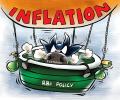
The RBI on Friday retained inflation forecast for FY23 at 6.7 per cent amid uncertain price trajectory on "geopolitical shocks" and on hope that inflationary pressures would ease with pick-up in kharif sowing and supply chain improvements. In its previous monetary policy review in June, it had projected retail inflation for 2022-23 at 6.7 per cent, higher from 5.7 per cent forecast in April. The six-member Monetary Policy Committee (MPC) unanimously decided to raise the benchmark repo rate by a steep 50 basis points to 5.40 per cent with immediate effect to tame inflation while supporting growth.

In 2013-14, Tata Motors produced 21,358 Nano models against the plant capacity of 250,000 vehicles.

Ajit Balakrishnan offers lessons from another tech revolution not so long ago.
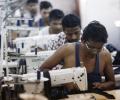
That prompted manufacturers to add jobs for the first time since June.

In April, the World Bank had projected India's GDP would grow at 6.1 per cent in the current financial year and at 6.7 per cent the following year.
